
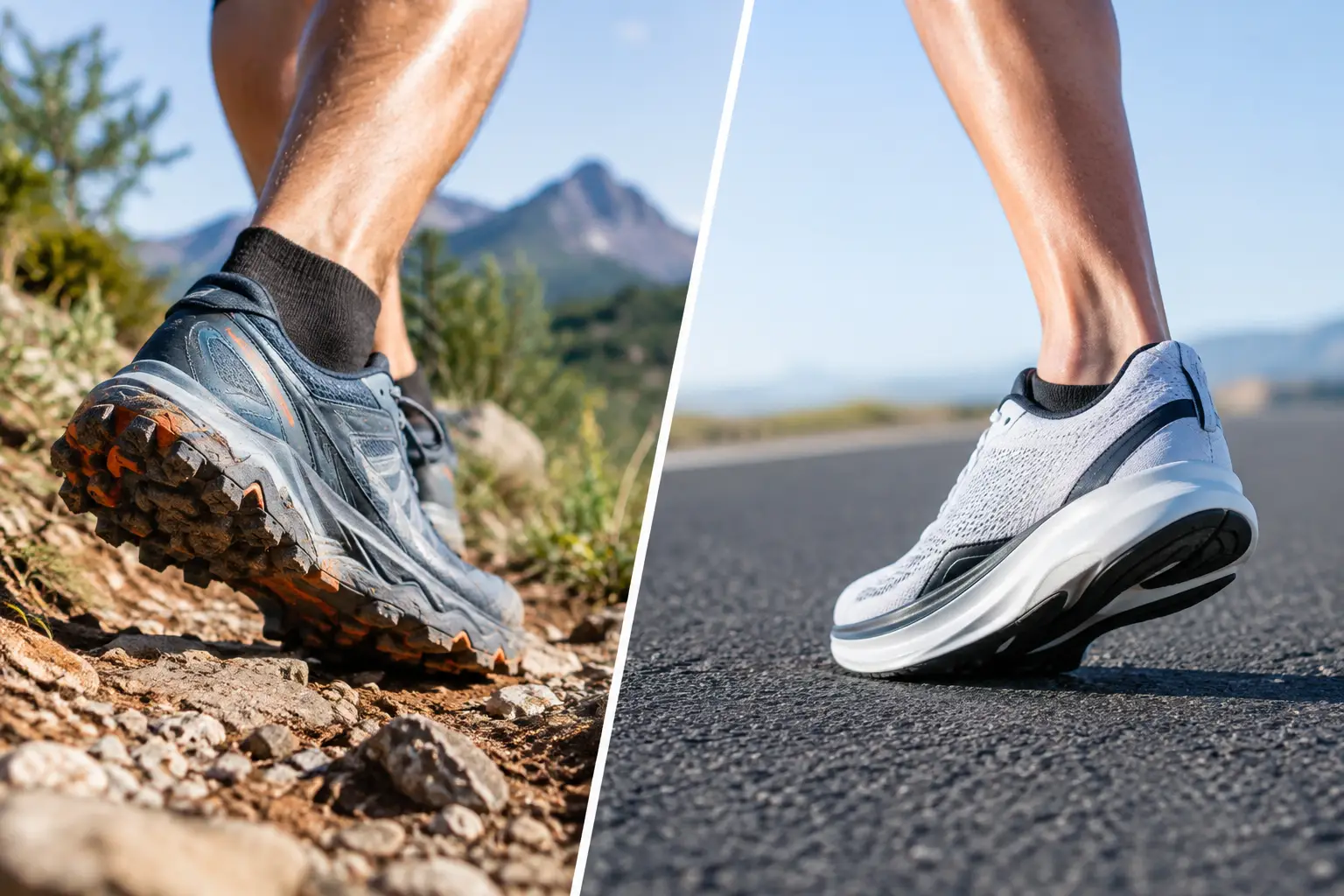
The last thing you want halfway through a muddy descent is to wonder whether your trainers are up to the job. A trail shoes vs road shoes race decision can feel minor at kit-check stage, but it changes how confidently you move, how hard your legs work and how much you enjoy the run.
For a SUPBIKERUN-style adventure, your footwear is not about looking the part. It is about finding a pair that lets you attack the hills, stay composed on uneven ground and still have enough comfort for the finish-line buzz. The right answer depends on the route, the weather and your own running style.
Trail Shoes vs Road Shoes Race: The Big Difference
Road shoes are built for predictable surfaces. Think tarmac, paved paths and compact tracks where the ground is largely smooth and the priority is efficient forward motion. They are usually lighter, more flexible and fitted with a flatter outsole. On a dry, fast course, that can feel brilliantly quick.
Trail shoes are made for the ground doing its own thing. Roots, loose stones, wet grass, mud, cambers and uneven descents all demand more from your feet. A trail shoe typically has deeper lugs for traction, a more protective upper and a firmer sole that helps shield your foot from sharp rocks.
Neither is automatically better. A road shoe is not a bad choice because a race takes place outdoors, and a trail shoe is not always the answer because a route includes a field. The useful question is this: what surface will you spend most of your running leg on, and what will it become if the weather turns?
When Trail Shoes Earn Their Place
Trail shoes come alive when grip and protection matter more than saving a few grams. If your race includes woodland trails, wet grass, loose gravel, rocky paths, steep climbs or technical descents, they give you a stronger platform to run with intent.
The lugs underneath are the obvious feature. They bite into soft ground where the flatter rubber on road shoes can slide around. That extra traction can make a serious difference on a muddy incline or when braking downhill. It is not just about speed. It is about reducing those little slips that drain confidence and make you run cautiously.
A trail shoe also tends to offer more structure around the foot. That can be reassuring on uneven terrain, particularly late in a race when fatigue makes foot placement less precise. Rock plates or firmer midsoles are useful where stones are sharp and plentiful, although they can make the ride feel less springy than a road trainer.
Choose trail shoes if the route is predominantly off-road, the forecast is wet, or you know you will be crossing terrain that demands attention. For an adventure event in Mid Wales, Devon or the Lake District, conditions can shift quickly, and grip is rarely something you regret bringing.
The trade-off: comfort on hard ground
Trail shoes are not magic boots. Deep, aggressive lugs can feel clumsy on long stretches of tarmac and may wear down faster there. Their firmer construction can also feel harsher if you are used to soft, cushioned road shoes.
If the course includes lots of pavement, do not simply buy the most heavily lugged option in the shop. Look instead for a versatile trail shoe with moderate lugs and enough cushioning to handle mixed terrain. That is often the sweet spot for runners who want one pair to do plenty.
When Road Shoes Can Be the Smarter Choice
Road shoes are ideal for routes that are mostly firm, dry and fast. A race around hard-packed gravel paths, towpaths, park trails and short grassy sections may be perfectly manageable in your usual road running shoes, especially if the ground has had a dry spell.
Their lighter feel is a genuine advantage. Road shoes often encourage a smoother stride and can feel more responsive when you are trying to hold a pace. If you have trained all season in one trusted pair, wearing it on a suitable course also avoids introducing a new fit, drop or level of support on race day.
Road shoes make most sense when the off-road element is mild rather than technical. A little dirt is not the same as a trail race. If you can run the route confidently in dry conditions without needing to pick your way around roots, rocks and slippery slopes, your road shoes may be absolutely fine.
The risk: wet grass changes everything
The trouble is that road shoes are less forgiving when conditions deteriorate. Damp grass can be as slippery as ice, and a muddy corner can turn a fast, familiar shoe into a liability. Their uppers may drain poorly too, leaving you carrying water after puddles or stream crossings.
Before committing, check the event information, study the terrain description and be honest about the forecast. If rain is likely and the route contains grass, woodland or loose ground, trail shoes are usually the more confident call.
Match Your Shoe to the Course, Not the Label
The best trail shoes vs road shoes race choice is rarely at either extreme. Most adventure races are mixed-surface affairs. You might leave a smooth path, head into rougher tracks, cross grass and gravel, then finish on firmer ground. For that kind of route, a door-to-trail shoe or all-round trail model can be a smart compromise.
These shoes usually have shallower lugs than a dedicated fell-running shoe but more grip than a road trainer. They are designed to roll comfortably on hard surfaces while still offering enough traction for ordinary British trails. For many recreational racers, that is exactly what race day requires.
Pay attention to the outsole rather than relying on the category printed on the box. Shallow, closely spaced lugs suit compact dirt and gravel. Deeper, more widely spaced lugs are better at shedding mud. A broad base can provide stability, while a very narrow, stripped-back shoe may feel nimble but demand stronger ankles and more careful footwork.
Fit Matters More Than Fancy Features
The best sole in the world cannot rescue a shoe that rubs your heel or crushes your toes. Trail running often involves descents, and your feet naturally slide forward under braking. Leave roughly a thumb’s width between your longest toe and the end of the shoe, while keeping the midfoot and heel secure.
Try shoes on with the socks you plan to race in. Walk downhill if the shop has a ramp, or at least lean forward and check whether your toes hit the front. A comfortable fit at the start is useful. A secure fit after an hour of running is essential.
Avoid making a dramatic footwear change in race week. New shoes need a few runs to reveal pressure points, hot spots and whether the lacing works for you. Take them on terrain that resembles your event, including hills if possible. Your feet deserve the rehearsal as much as your pacing plan does.
Think Beyond the Sole
Socks, lacing and weather preparation have a bigger impact than many runners expect. Technical socks that stay put can prevent rubbing, while a simple heel-lock lacing technique can reduce toe bang on descents. If you are prone to blisters, test your preferred tape, balm or sock combination during training rather than gambling on race morning.
Waterproof trail shoes sound appealing, but they are not always the best choice. They can keep out light rain and wet grass, yet once water enters over the ankle, they may take longer to drain. For routes with proper puddles, stream crossings or persistent rain, a breathable shoe that dries and drains well can be more comfortable.
Also consider how tired legs affect your decision. A shoe that feels lively for a 30-minute run may feel unstable after cycling and paddling, when your concentration is already being tested. Choose footwear that makes you feel capable, not cautious.
A Quick Race-Day Decision
If your route is largely paved or hard-packed, dry and non-technical, road shoes are a sensible, fast option. If it is muddy, uneven, steep or scattered with roots and stones, trail shoes should be the default. For a mixed adventure course, choose a versatile trail shoe with moderate grip rather than going too specialised.
Most importantly, trust the pair you have trained in. Race day is not the moment to prove you can cope with a more aggressive shoe, less cushioning or a completely different fit. The aim is simple: spend less energy worrying about your footing and more energy enjoying the challenge around you.
Bring the shoes that make you want to charge towards the next hill, then give them a proper muddy test before the start line.