
A wobbly start can cost more energy than the first few hundred metres of a paddle leg. Knowing how to mount paddleboard quickly is not about launching yourself onto the deck in a panic. It is about using a repeatable movement that gets you stable, settled and ready to move while everyone around you is still finding their footing.
For a SUPBIKERUN-style challenge, that matters. You may be stepping onto your board with excited nerves, a race bib on and a bike and run still to come. Start cleanly, keep your breathing under control and save the drama for the finish line.
Set yourself up before you touch the water
The fastest mount starts on dry land. Check that your leash is fitted correctly and attached to the board’s leash point, usually at the tail. Your paddle should be within easy reach, with the blade facing the right way: angled forwards when you hold it upright. A backwards blade turns every stroke into extra work.
Before entering, take a moment to find the board’s centre point. Most inflatable paddleboards have a carry handle in the middle, and that is your best reference. Your knees and feet need to land either side of it. Too far back and the nose rises; too far forward and you may push the nose under the surface.
If you are in an organised event, follow the launch instructions rather than racing towards the waterline. A few calm seconds in the right place are quicker than getting tangled with another paddler or being asked to move back out of the channel.
How to mount a paddleboard quickly from shallow water
Walk your board out until the fin has enough depth to clear the bottom. For most boards, that means water around knee deep or a little deeper. Keep one hand on the centre handle or rail so the board stays pointing away from shore, ideally into any small chop rather than side-on to it.
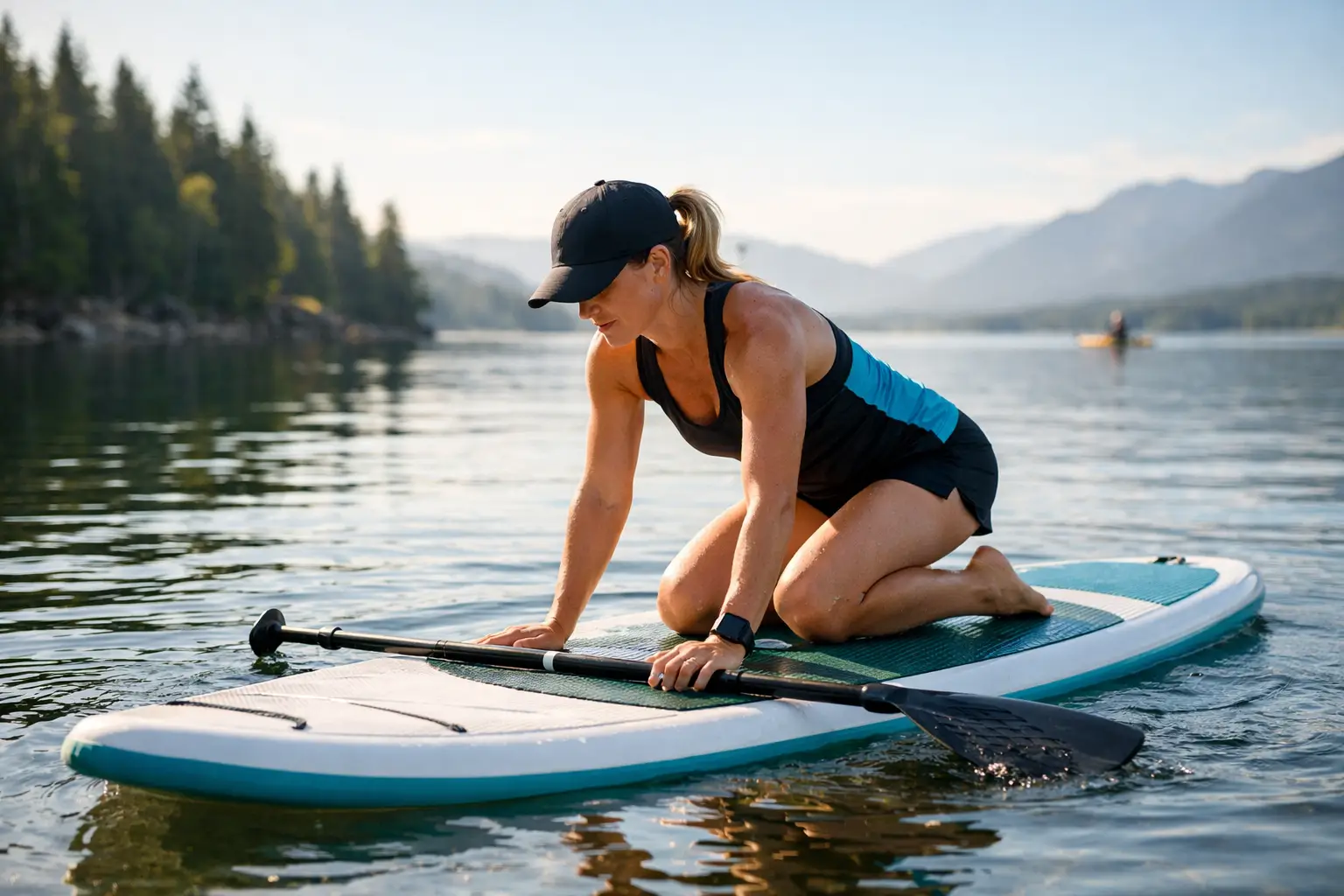
Place your paddle across the board, within reach, with the shaft laid across the deck pad. Then hold both rails around the centre handle. In one smooth movement, push off the bottom, bring your chest over the board and slide your body on so your knees land either side of the handle.
Do not try to stand immediately. That is the classic energy-waster. Pause on your knees, straighten the board’s line and take two or three easy strokes. You are looking for forward momentum, because a moving board is generally more stable than one sitting still.
Once the board feels settled, bring one foot forwards where your knee was, then the other. Keep your knees bent, your eyes on the horizon and your hands low on the paddle. Stand up through your legs rather than pulling yourself upright with the paddle.
The whole sequence should be controlled, not rushed: launch, knees, glide, stand. Practise it until it feels like one movement.
The quickest method if you fall in
Falling off is part of paddleboarding, particularly when the water is choppy, you are tired or someone else’s wake catches you off guard. The faster you reset, the less it affects your race.
First, make sure you and your board are safe. Hold on to the board or leash, get to the side around the centre handle and turn the board so it is facing into the wind or chop where possible. Keep the paddle in one hand if you can do so without fighting for it. If not, secure yourself to the board first, then retrieve it.
With both hands on the far rail, kick your legs behind you and pull your chest across the centre of the board. Your legs should trail behind for a moment rather than trying to climb on from the side. Once your stomach is on the deck, rotate onto your knees and get moving again.
Avoid hauling yourself up near the tail. The board will tip or shoot forwards, and you will use far more upper-body strength than necessary. The centre is the stable zone. Find it every time.
Why speed comes from balance, not bravado
There is a trade-off in every fast transition. Move too cautiously and you lose time; move too aggressively and a second splash can cost more than a composed mount ever would. The aim is not to be the first person standing. It is to be the first person paddling efficiently.
A stable kneeling start is especially valuable if you are new to SUP, carrying fatigue from an earlier discipline or launching in a busy group. Stronger, more experienced paddlers may be able to stand almost immediately in calm conditions. Even then, taking a couple of strokes on your knees can be the smart call in crosswinds, boat wash or a congested start.
Think of your paddle as a third point of contact. As you rise, keep the blade in the water beside the board and apply light pressure through it. Do not lean heavily on it, as the blade can slip, but use it to give your body a useful balance cue while your feet settle.
Common mistakes that make mounting harder
Most mounting problems have a simple cause. Looking down at your feet makes your upper body fold forwards and encourages the board to wobble. Keep your gaze ahead instead. Standing with straight legs has the same effect: your knees need to stay soft enough to absorb movement from the water.
Another frequent mistake is holding the paddle too tightly. A death grip travels up into your shoulders, shortens your stroke and makes every wobble feel bigger. Relax your fingers, stay loose through the arms and let your legs do the balancing.
Board position matters too. If the board is sideways to wind or small waves, it will be pushed under you as you climb on. Point the nose into the conditions before mounting. It is a tiny adjustment with a big payoff.
Finally, do not wait until event day to discover whether your leash, buoyancy aid or footwear changes your movement. Your kit should make you feel secure, not unfamiliar. Practise wearing the same essentials you plan to use on the water.
Build a race-ready mount in training
You do not need a long technical session to improve. Add five to ten mounts to the start of an ordinary paddle, beginning in calm, sheltered water. Alternate between a shallow-water start and a remount from the water. Focus on placing your knees around the carry handle, getting two strokes in before standing, and keeping your eyes up.
As confidence grows, practise with a little more challenge: light wind, gentle boat wake or after a short burst of effort. That is closer to how a transition can feel when your heart rate is high. Always choose conditions that are within your ability and never practise alone in cold, deep or unfamiliar water.
For an event day, give yourself permission to use the technique that keeps you moving. A quick kneeling launch followed by a solid stand is better than an ambitious leap that ends with a swim. The strongest paddlers are not always the ones who look flash at the water’s edge. They are the ones who stay calm, find their rhythm and make every stroke count.
Bring that approach to your next paddle: launch with purpose, settle fast and enjoy the moment the board starts to glide.