
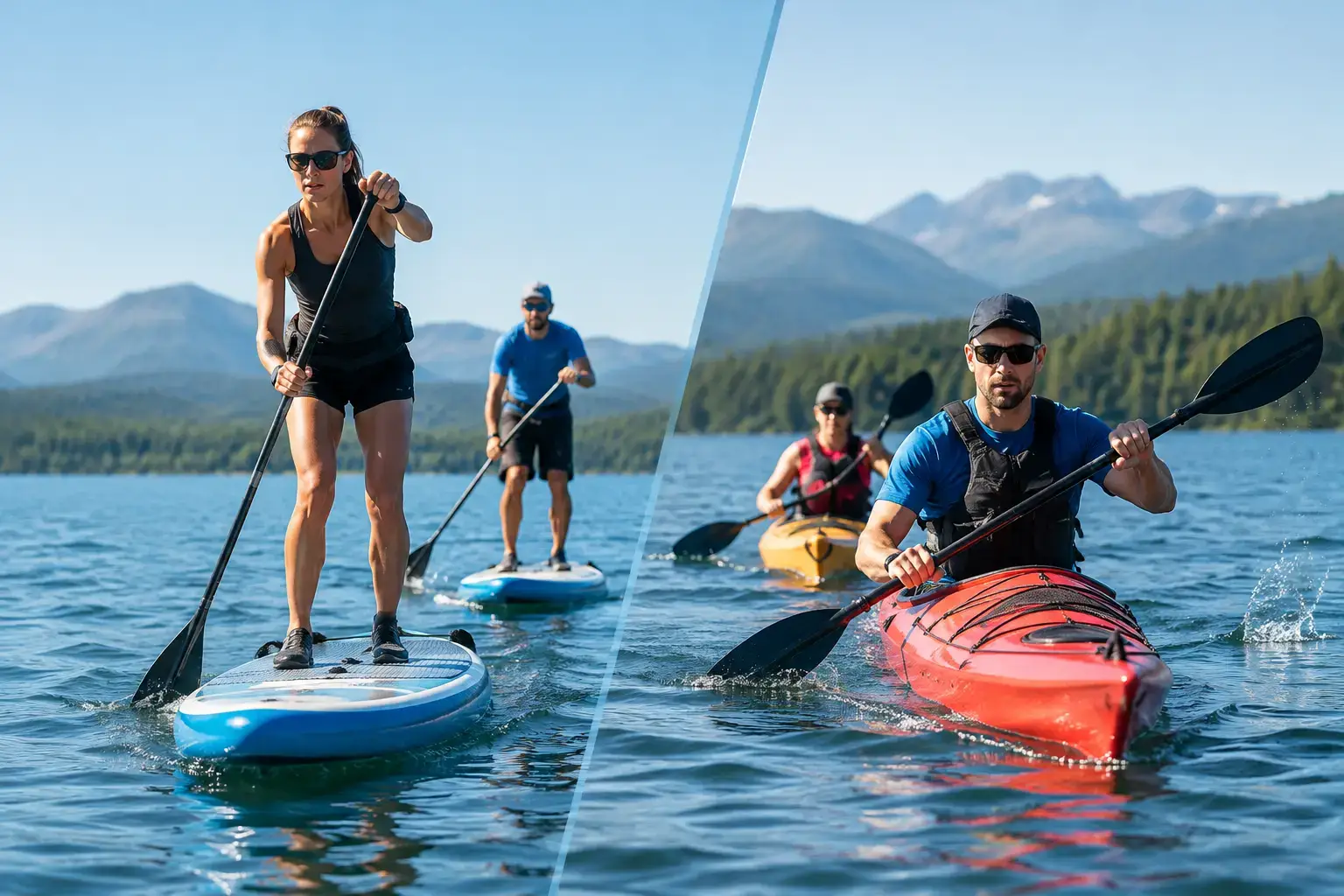
A start line beside the water has a way of making every athlete feel like a beginner again. That is part of the magic. But when choosing between a paddleboard race vs kayak race, the craft beneath you changes far more than your view of the course. It changes the skills you need, the effort you feel, and the kind of finish-line story you take home.
For some, a kayak is the fast, familiar choice: sit in, settle down, pull hard. For others, a paddleboard delivers the outdoor adventure they came for: stand tall, find your rhythm and earn every metre. Neither is automatically tougher. The right one is the one that makes you excited to train, not merely nervous about race day.
Paddleboard race vs kayak race: the real difference
The biggest difference is your connection to the water. On a paddleboard, you are standing above it with your feet constantly making tiny adjustments. Your legs, feet and core are working throughout, even when the water looks calm. In a kayak, you are seated lower and more securely, using a combination of torso rotation, leg drive and upper-body power to propel the boat.
That makes a paddleboard race more exposed, more physical in a whole-body way, and often more sensitive to wind and chop. A kayak race usually allows a more consistent paddling rhythm and, depending on the craft, greater outright speed. It can feel more familiar to anyone with a background in rowing, canoeing or endurance cycling: settle into a sustainable effort, stay efficient and keep moving.
Neither discipline is a free ride. A quick paddler on a board will leave plenty of kayakers behind, while a skilful kayak paddler can make serious speed look effortless. The comparison is less about which craft is superior and more about what kind of challenge you want.
What a paddleboard race asks of you
A paddleboard race rewards balance, composure and smart pacing. Your first task is not simply to move forward. It is to stay relaxed enough to move efficiently while the board moves beneath you.
Balance is part of the race
On flat water, a stable inflatable or hard board can feel wonderfully approachable. Add a crosswind, boat wash or a busy turning buoy and the demands rise quickly. That does not mean you need to be an elite paddler to take part. It means your preparation should include time on the board in conditions that are not perfectly glassy.
A fall is rarely a disaster. In fact, learning to remount quickly and calmly is one of the most useful race skills you can practise. The confidence that comes from knowing you can get back on, reset and carry on is worth far more than trying to avoid every wobble.
Your core and legs will notice
Standing changes the effort completely. A paddleboard stroke uses the shoulders and back, of course, but your legs provide the platform and your core transfers the power. Many first-time racers are surprised by tired feet, calves or hip flexors before their arms feel done.
This can make SUP a brilliant match for athletes who enjoy trail running, mountain biking and varied terrain. You are always reading the surface and making small adjustments. It feels active, absorbing and a little wild.
Technique matters more than muscling through
Beginners often use short, hurried strokes with their arms. It is exhausting. A stronger approach is to reach forward, plant the paddle cleanly, rotate through your torso and pull the board past the paddle. Keep your top hand stacked over the lower hand and resist the urge to paddle only from the shoulders.
You do not need perfection. A few coached sessions or focused practices can make a dramatic difference to comfort and speed. On race day, smooth is fast.
What a kayak race asks of you
A kayak offers a more planted, lower-centre-of-gravity experience. That can be reassuring for paddlers who want to focus on pace rather than balance, especially over longer distances or in mixed weather.
Expect a steadier rhythm
With your body supported by the seat and your feet braced, you can apply power consistently. Good kayak technique still starts from the core, not just the arms. Rotation through the torso, pressure through the footrests and a clean catch in the water all help turn effort into forward movement.
For people moving into paddle sport from cycling or running, this dependable rhythm can feel immediately satisfying. There is less time spent managing the craft and more opportunity to find a tempo, watch your heart rate and chase the person ahead.
Speed can be addictive
A kayak will often carry momentum better than a paddleboard, particularly if it is a longer, narrower craft designed for racing. That makes it appealing to competitors who love the feeling of covering ground efficiently.
There is a trade-off. Faster boats can be less stable and more technical to turn, launch and handle in choppy water. A recreational sit-on-top kayak is generally forgiving but may not glide as quickly as a performance kayak. Check the event rules before assuming any boat is suitable – craft specifications, buoyancy requirements and safety equipment can vary.
Comfort and confidence still need attention
Being seated does not guarantee an easy day. Poor posture, a badly adjusted footrest or a paddle that is the wrong length can leave you with sore shoulders, a stiff lower back or numb feet. Spend time setting up your kayak before race morning, and do not make your first proper paddle the event itself.
Which race suits your training and personality?
Choose a paddleboard race if you want the water leg to feel like an adventure in its own right. It suits athletes who enjoy a technical challenge, have decent balance, and do not mind getting wet. It is also a natural fit if you are drawn to the stand-up paddleboarding community and want a discipline that feels refreshingly different from conventional endurance sport.
Choose a kayak race if you want a stable platform for sustained effort, or if you are motivated by speed and a more repeatable rhythm. It may be the better starting point for someone who is less confident standing on moving water, although you should still build basic open-water confidence.
Your local water matters too. A sheltered lake or calm canal gives paddleboard beginners room to learn. Windier reservoirs, tidal waters and exposed courses demand more judgement from every paddler, whatever the craft. Conditions can make a comfortable board feel challenging, or turn a quick kayak outing into a serious test of control.
The practical race-day considerations
The choice is not just physical. It affects logistics. Paddleboards, particularly inflatables, can be easier to transport and store, though you need time and space to inflate them properly. Hard boards need roof-rack confidence and careful handling. Kayaks are bulkier, while a sit-on-top can be wonderfully simple at the water’s edge.
For either craft, wear clothing that works when wet rather than clothing you hope will stay dry. Dress for the water temperature, not just the air temperature. A buoyancy aid is an essential piece of kit where required, and a leash is standard for SUP in suitable conditions and where event rules permit it. Race organisers set their safety policies for good reason, so read the participant information carefully and arrive ready.
If you are entering a multi-discipline challenge, think beyond the paddle leg. A hard kayak effort can load your shoulders and upper back before the bike and run. A SUP leg can fatigue your calves, hips and core. Practise transitions and fuel properly so your chosen craft supports the whole day rather than stealing all your energy early.
At SUPBIKERUN, that blend is exactly where the fun lives. The paddle is not a warm-up for the rest of the course. It is a proper adventure, followed by the bike and trail run challenge that makes the finish feel earned.
How to make the decision without overthinking it
If you can, try both on the same stretch of water. Give each craft at least two or three outings, including one when there is a little breeze. Notice what happens after 30 minutes: are you grinning, settling into a rhythm and wanting another go, or counting the minutes until you finish?
Also be honest about access. The best craft is often the one you can use regularly. A board that fits in the boot and gets you on the water every week may be a better race choice than a sleek kayak that rarely leaves the garage.
Whatever you choose, start building confidence now. Practise turns, stopping, getting back on after a fall or capsize, and paddling around other people without panic. Then turn up ready for the nerves, the laughs and that brilliant first stroke away from the line. The water does not ask you to be perfect. It asks you to get out there.