
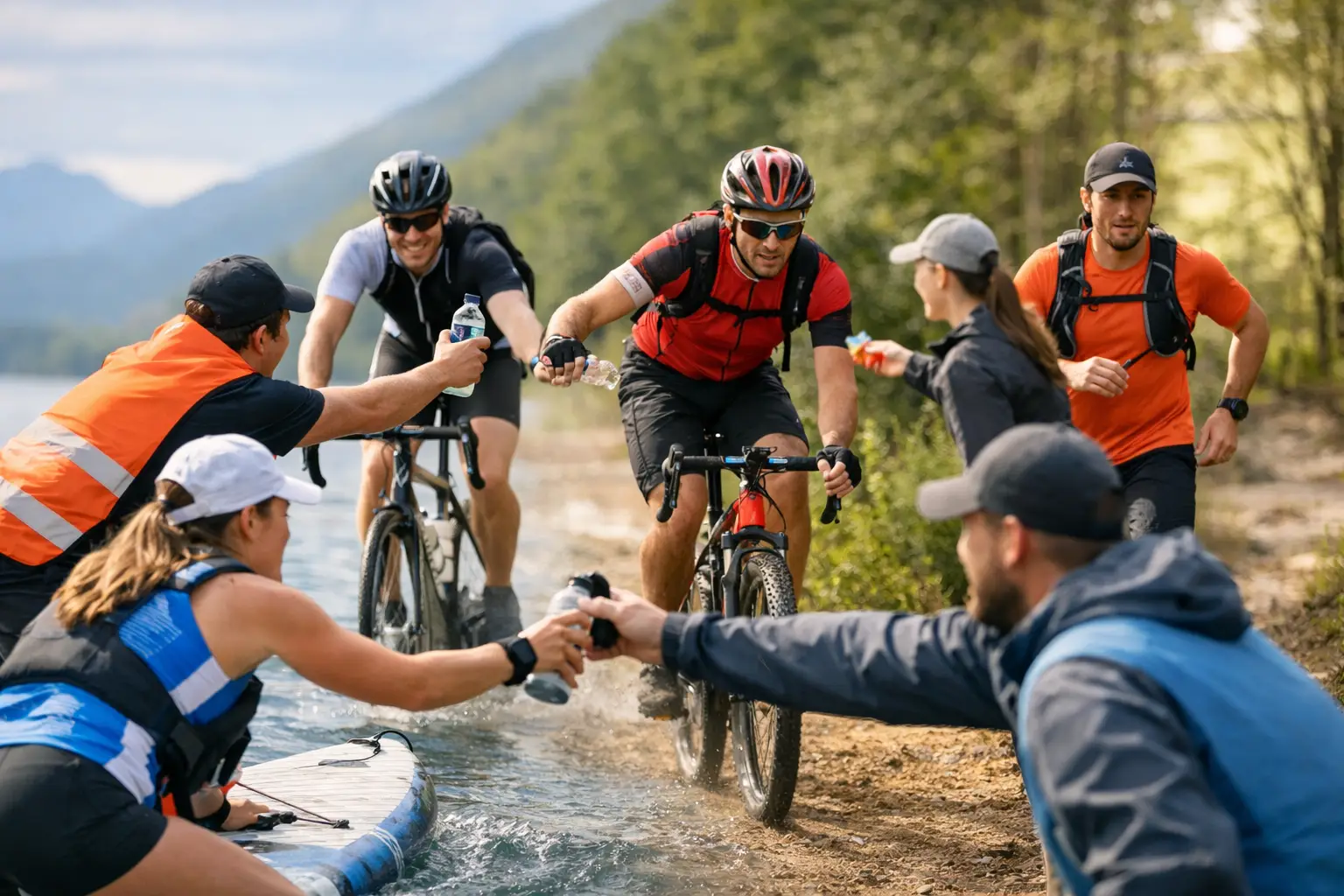
The first competitor might only see you for ten seconds at a marshal point. But when they are tired, muddy, unsure of the route and running on determination alone, those ten seconds can change their whole day. That is why volunteer at races is a question with a far better answer than a free coffee and a bright hi-vis vest.
Volunteering puts you at the beating heart of an event. You see the nerves at registration, the friendly rivalries on the start line, the grit on the course and the finish-line moments people will talk about for years. Better still, you help make every one of those moments happen.
For anyone who loves paddle boarding, cycling, trail running or simply being outside among people doing brave things, race volunteering is one of the best ways to spend a weekend.
Why volunteer at races? You become part of the experience
A race is never just the people wearing race numbers. It is built by the team checking participants in, marking the course, handing out water, managing transitions, encouraging competitors and making sure everyone gets home safely.
As a volunteer, you are not on the sidelines looking in. You are part of the crew that gives the day its energy. A well-timed cheer at the top of a climb, a clear direction at a junction or a reassuring word before a paddle section can be exactly what a participant needs.
That connection is particularly powerful at adventure events. The course might take people through open water, woodland trails and challenging bike sections, where the landscape is part of the test. Competitors remember the people who helped them keep moving as much as they remember their finish time.
There is a simple satisfaction in knowing that, because you turned up and got stuck in, hundreds of people were able to take on something bigger than their usual weekend routine.
See the race from a completely different angle
If you usually race, volunteering gives you a useful change of perspective. You start to understand how much planning sits behind the start horn: route signage, timing points, safety briefings, transition layouts, kit checks, parking, catering and contingency plans.
That does not take the magic away. It tends to add to it. Seeing an organised team turn a field, lakeside or trail network into a safe, buzzing event village gives you a new appreciation for the sport and the people who make it possible.
You also get a front-row seat for the full emotional range of race day. There are fast athletes chasing a target, first-timers wondering whether they can do it, friends racing side by side and finishers who are visibly amazed by what they have achieved. It is hard not to take some of that motivation home with you.
For people considering their first event, volunteering can be the perfect scouting mission. You can see how registration works, what people wear, how transitions flow and what the atmosphere really feels like. It is much less intimidating than imagining it all from a training plan.
Build skills that travel beyond race day
Volunteering is hands-on. Depending on the role, you could gain confidence in communication, teamwork, problem-solving, customer service, route awareness and event operations.
Marshalling is a great example. You need to stay alert, give clear information, remain calm if plans change and make participants feel supported without distracting them from the course. It is a real responsibility, but you will be briefed and supported by the event team.
Registration roles suit people who enjoy a fast-paced, social start to the day. You might be welcoming athletes, checking details, handing out race packs or answering practical questions. Finish-line and feed-station roles are ideal if you bring big energy and can keep spirits high when the hard work is catching up with competitors.
For corporate groups, volunteering offers something more meaningful than a standard team activity. Working together outdoors, taking ownership of a role and seeing the direct result of your efforts can build stronger connections than an afternoon in a meeting room ever will.
Meet people who get it
Training for an event can sometimes feel like a solo mission. Volunteering reminds you that endurance sport is also a community.
You will meet experienced racers, newcomers, outdoor enthusiasts, event professionals and fellow volunteers who understand the appeal of an early start, wet shoes and a good post-race story. Conversations happen naturally while setting up flags, waiting at a marshal point or helping pack down after the last finisher is safely through.
You do not need to arrive with a group. Many volunteers come alone and leave with new faces to train, race or simply share a coffee with later. If you are new to a local area, looking to return to sport after time away or want to find your adventure crowd, it is an easy place to begin.
At SUPBIKERUN, that spirit matters. The challenge is real, but so is the welcome. The best event weekends are built on people looking out for one another, whether they are racing, volunteering or cheering from the course edge.
You can choose a role that suits your weekend
Race volunteering is not one-size-fits-all. Some people love the first-light buzz of registration and set-up. Others prefer being out on course, where the action is spread across the day. If you thrive on atmosphere, the finish line is hard to beat. If you like practical jobs and a clear task, course set-up or pack-down may be right up your street.
You do not need to be an elite athlete or an expert in every discipline. Most events need reliable, positive people more than they need technical specialists. Where a role requires specific knowledge, such as water safety or bike support, organisers will make that clear and provide the relevant guidance.
Be honest about what works for you. An outdoor marshal role can involve long periods on your feet and unpredictable weather. A busy registration desk can be full-on early in the morning. Volunteering is rewarding, but it is still a commitment, so choose a shift you can arrive for on time and complete with focus.
What makes a brilliant race volunteer?
The best volunteers are not necessarily the loudest. They are prepared, approachable and present. They listen during the briefing, know where they need to be and ask if they are unsure. They understand that a competitor who seems short-tempered may simply be nervous, exhausted or concentrating hard.
Bring suitable clothing for the conditions, especially for outdoor roles. Layers, waterproofs, sturdy footwear, sun protection and a refillable bottle can make a long shift far more comfortable. Check whether food is provided, where to park and when to arrive before you travel.
Once you are there, focus on the job in front of you. Be encouraging, but do not give course or safety advice beyond your briefing. If something does not look right, tell the event lead immediately. Good event teams would always rather hear about a small concern early than deal with a bigger issue later.
Most importantly, bring your personality. A cheerful welcome, an accurate direction and a genuine “you’ve got this” cost nothing, yet they can carry someone through a difficult mile.
Try before you race, or give back after your finish
There are two brilliant times to volunteer. The first is before you take on an event yourself. You will learn the rhythm of race day, understand the kit and get a realistic feel for the challenge without pressure to perform.
The second is after you have raced. You know what it feels like to scan for a course marker, need a water refill or hear your name near the finish. That experience makes you an especially empathetic volunteer.
Of course, it depends on your goals. If you are in the middle of a focused training block, an early start and a full day outside may not be ideal before a key session. If you want to stay connected to the sport while recovering from injury, taking a break from racing or supporting a friend, volunteering can be exactly the right kind of active weekend.
Race day is full of people proving something to themselves. Stand on the other side of the course tape for once, help make that moment possible and you may find your own reason to come back.