
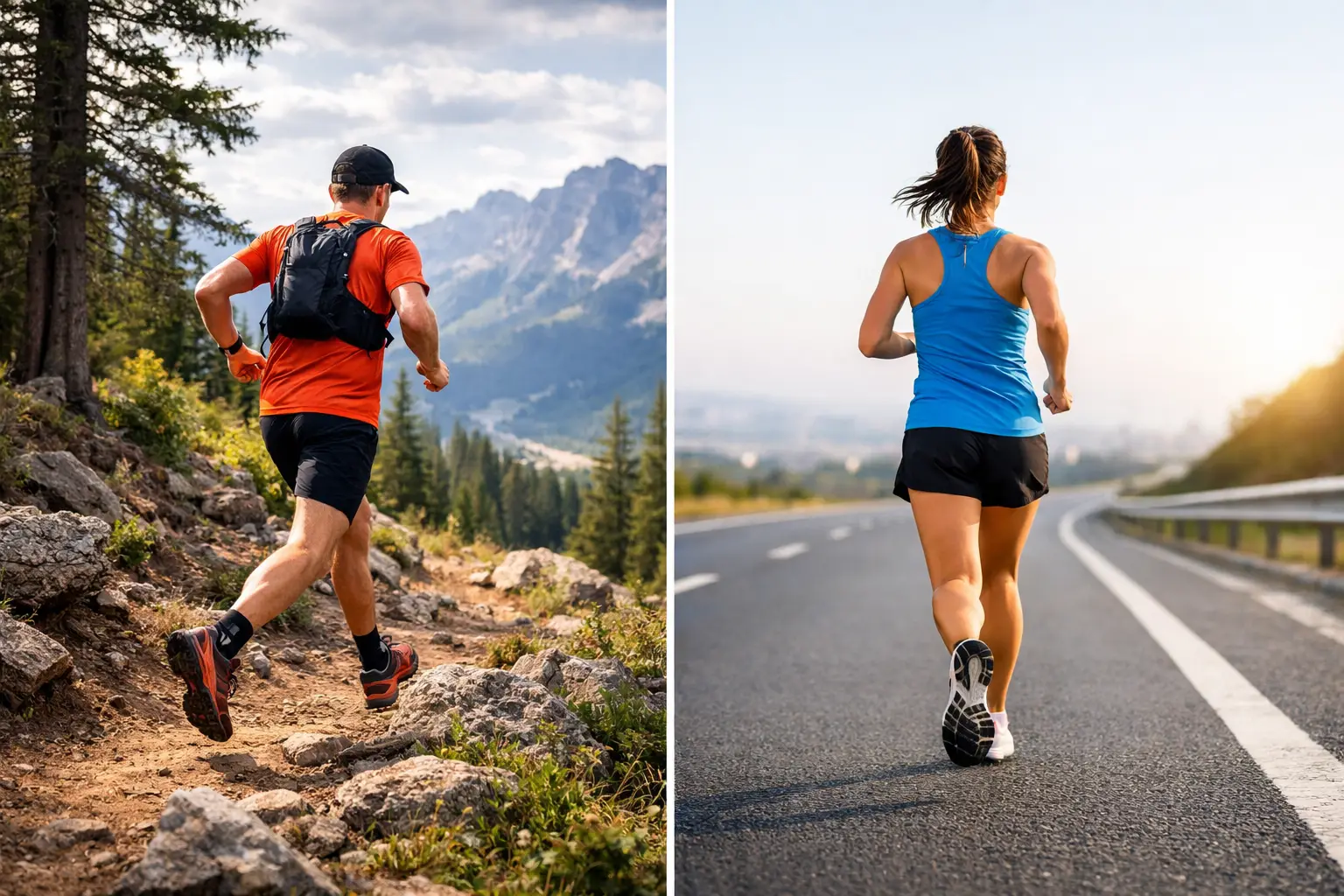
A finish time can tell a very different story when one runner has flown along closed tarmac and another has climbed muddy singletrack, hopped roots and battled a headwind on the ridge. Trail running vs road running events are not simply the same race on different ground. They ask different questions of your fitness, focus, kit and sense of adventure.
Neither is automatically harder. A fast road 10K can hurt from the gun, while a trail race can turn every kilometre into a fresh problem to solve. The best choice comes down to what gets you excited enough to train, turn up and give it a proper go.
Trail running vs road running events: the real difference
Road events are built around consistency. The surface is predictable, distances are usually precise, and a clear route lets you settle into a rhythm. Whether you are chasing a new 5K personal best or taking on your first half marathon, the challenge is often about holding a pace that feels just uncomfortable enough for as long as possible.
Trail events trade that predictability for variety. You may run through woodland, across open hills, along gravel tracks and over rough ground in a single outing. A steep climb can force even strong runners into a power hike. A wet descent can demand patience rather than bravery. Your average pace may look slower, but that says very little about the effort involved.
That difference changes the atmosphere, too. Road races often have packed spectator points, loud starts and a brilliant sense of shared momentum. Trail events can feel more spacious and exploratory, with a field of runners stretching along the route and volunteers cheering from places that took real effort to reach.
For many people, that is the appeal. You are still racing, but you are also moving through a landscape rather than simply getting from start line to finish line.
What your body is asked to do
On the road, repetitive impact is the main physical theme. Each stride lands in much the same way, which makes efficient technique and sensible pacing valuable. The steady surface suits runners who enjoy measuring progress through splits, pace bands and repeatable training sessions.
Trail running recruits more of the small stabilising muscles around your ankles, hips and core. Uneven terrain changes your stride constantly. You shorten it for rocks, lift your feet over roots, lean into climbs and control your momentum downhill. It is an all-body effort, especially when the route has proper elevation.
That does not mean trail running is gentler. Soft ground can reduce pounding, but technical descents and long climbs place their own demands on calves, quads and Achilles tendons. Equally, road running is not always flat or easy. Plenty of UK road races include sharp hills and exposed sections where the weather has other ideas.
If you are moving from road to trail, leave your ego at home for the first few runs. Slow down, look ahead rather than at your shoes, and let effort guide you more than pace. If you are moving from trail to road, build the volume gradually. The more uniform impact can catch out runners whose legs are used to varied terrain.
Pace is useful, but effort is king on the trails
A road race gives you clean feedback. If you ran 10 kilometres at a certain pace last month, you have a useful marker for your next attempt. GPS watches, kilometre signs and marshalled courses all support that head-down, focused style of racing.
On a trail course, pace is only one part of the picture. Gradient, surface, weather and navigation all affect it. One muddy kilometre may take twice as long as the last, even when you are working just as hard. For that reason, trail runners often race by perceived effort, heart rate or simply the feeling of staying in control.
This can be liberating. A trail event gives you permission to hike the steep bits, walk through a muddy bottleneck or take a breath at the top before descending. That is not failing to run. It is racing the terrain intelligently.
Road runners who love a target time may prefer the certainty of tarmac. Trail runners who enjoy responding to the day as it unfolds may find a perfectly paced road race a little too controlled. Both mindsets are valid, and plenty of runners enjoy switching between them through the year.
Kit choices can make or break race day
Road events keep kit simple. Comfortable shoes, socks that have been tested in training, weather-appropriate layers and a way to carry any essentials are often enough. On shorter routes, water stations may mean you need very little on your person.
Trail events deserve a bit more preparation. Trail shoes with suitable grip can add confidence on loose or wet ground, although the right choice depends on the route. Deep lugs are helpful in mud but can feel clumsy on hard-packed paths. A lighter shoe may be ideal for dry, runnable trails. Check the event briefing rather than buying kit based on a dramatic photo.
Weather matters more when you are out in exposed country or moving at variable speeds. A lightweight waterproof, an extra layer, a fully charged mobile phone and enough food and fluid may be essential rather than optional. Some events have mandatory kit for good reason: conditions can change quickly, and support may be further apart than it is on a town-centre road course.
Whatever the surface, never save new shoes, socks, shorts or fuelling products for race day. Your event should provide the excitement, not a surprise blister or a stomach that objects halfway round.
Organisation matters in different ways
A well-run road race is a thing of beauty. Clear signage, road closures, bag drop, timing chips, accessible aid stations and enthusiastic marshals let runners focus fully on the effort. Larger events can also make it easier for friends and family to watch, travel in and celebrate with you afterwards.
A well-run trail event needs all that care, plus thoughtful route marking, trained marshals in remote spots, clear cut-off information and realistic advice about terrain. The route may cross working land, sensitive habitats or areas where public access needs to be respected. Good event organisation protects runners, landowners and the landscape at the same time.
This is especially relevant if you are choosing an adventure event with trail running as one part of the challenge. At SUPBIKERUN, the run is not an add-on after the paddleboard and bike. It is part of the experience: legs tired, head clear, and a proper sense of earning the finish with the people around you.
Before entering any event, read the route notes, elevation profile, kit requirements, cut-offs and transport details. A race can be welcoming to first-timers while still requiring proper preparation. Those two things belong together.
Which event is right for you?
Choose a road event if you enjoy structure, want a reliable way to test your speed, or are building confidence over a known distance. Road races are brilliant for first events because the logistics are often straightforward and the crowd energy can carry you through a difficult patch.
Choose a trail event if you want a challenge that feels less scripted. You do not need to be an elite mountain runner. You do need to be happy getting muddy, adjusting your plan and accepting that a walk uphill may be the smart move. The reward is a race day with more variety, more fresh air and usually more stories by the finish line.
For corporate groups and mates entering together, trail events can be particularly good at levelling the field. Fast runners still have an advantage, but terrain encourages people to look out for one another, regroup at key points and share the experience. The finish feels personal, even when you have tackled it as a team.
Train for the course, not just the distance
The most useful preparation matches the event ahead. For a road race, include steady runs, controlled tempo efforts and sessions that help you learn your target pace. Practise eating and drinking while moving if you are racing beyond shorter distances.
For a trail race, seek out hills and uneven ground where you can. Add walking climbs with purpose, practise controlled descending, and build time on feet rather than obsessing over kilometres. If your local options are limited, use inclines, stairs or a treadmill at a gradient, then make the most of weekend routes when you can.
Most importantly, practise the conditions you expect. If the forecast says rain, know how your shoes behave when wet. If the race starts early, try an early training run. If it is part of a multi-discipline adventure, learn how your legs feel when running after cycling. Small rehearsals remove a lot of race-day uncertainty.
The right event is the one that makes you look at the calendar, circle a date and think, “That will be a challenge.” Whether that challenge is a fast stretch of road or a muddy climb through the hills, commit to the training, trust the event team and enjoy every hard-won step towards the finish.