
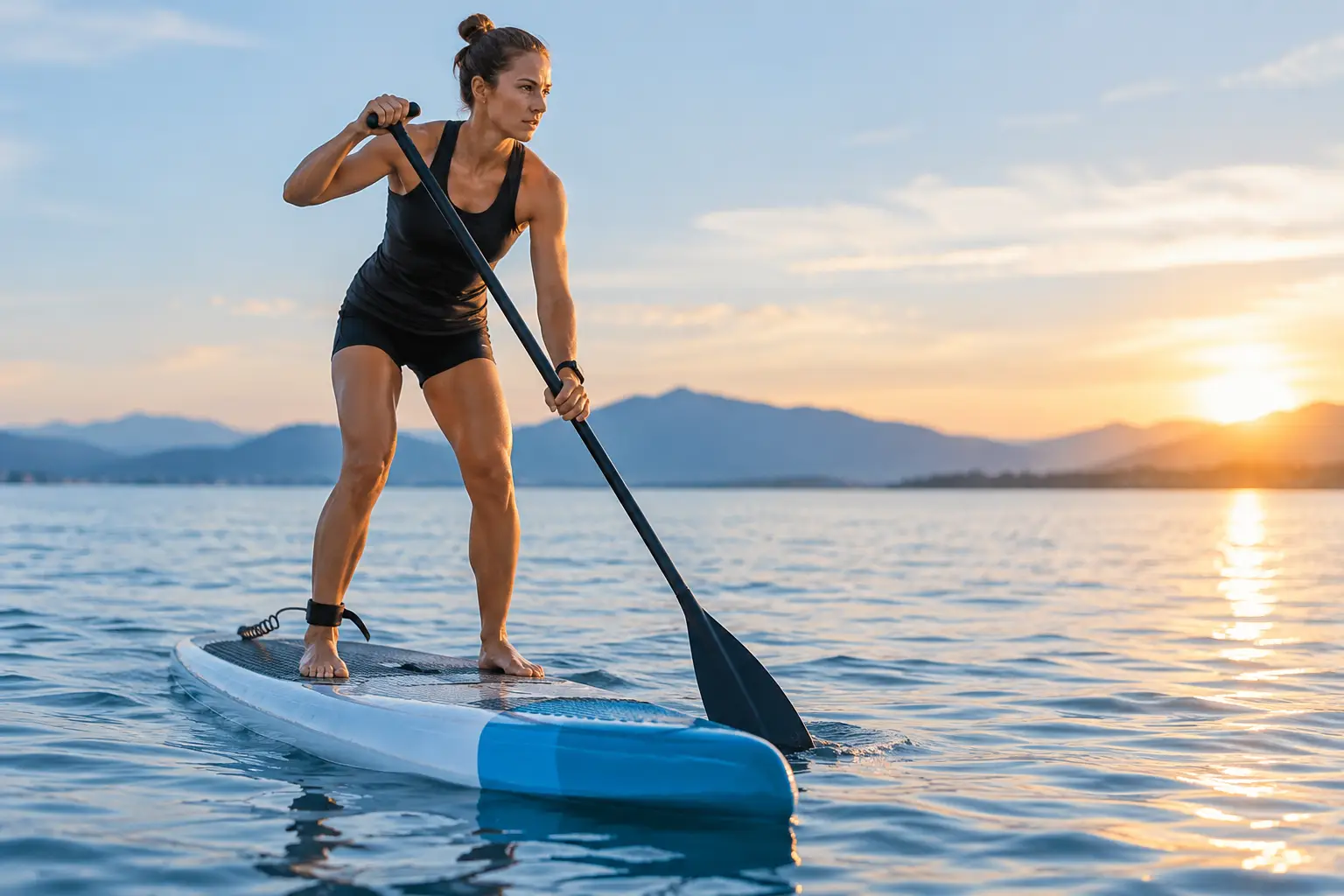
A paddle that is slightly too long can make a calm stretch of water feel like hard work. One that is too short can leave you folding forwards, losing reach and loading your lower back. Knowing how to choose paddle length gives you a cleaner, more comfortable stroke – and more energy left for the bike and trail run.
For an adventure triathlon, the goal is not to chase a perfect number printed online. It is to find a length that suits your body, board, stroke style and the way you want to paddle on race day. Get that right and every stroke feels more connected.
How to choose paddle length for your SUP
The simplest starting point is your height. Stand upright, barefoot if possible, and place the paddle beside you. For most recreational SUP paddling, the top of the handle will sit around 15 to 25cm above your head.
That range is a starting point, not a rule carved into a lakeside sign. A shorter setting generally suits a quicker, higher-cadence stroke and can feel more natural on choppy water or when accelerating. A longer setting can give you more reach and leverage, but only if you can keep good posture and place the blade cleanly in the water.
For a flatwater race effort, many paddlers land somewhere around 20 to 25cm above their height. If you are new to paddleboarding, start nearer the lower end of that range. You can always extend an adjustable paddle by a centimetre or two after a few sessions. Starting too long is the more common mistake, especially among tall, strong athletes who assume more leverage must mean more speed.
Use the overhead test, then paddle
A quick fit check is useful before you launch. Raise one arm straight above your head without shrugging your shoulder. The paddle handle should usually reach around your wrist crease when the blade is resting on the ground beside you. This normally places you in a sensible all-round range.
Then test it where it matters: on the water. Paddle easily for five minutes, switching sides regularly. Your top arm should be able to reach forwards without your shoulder creeping towards your ear. Your lower arm should be comfortably bent during the power phase, rather than locked straight or cramped against your body.
A good paddle length lets you hinge from the hips, reach forwards and plant the blade near the nose of the board without rounding your back. You should feel like you are pulling the board past a planted blade, not yanking water behind you with your arms.
If you find yourself lifting the blade high to clear the water on every recovery, or your shoulders feel tight after a short paddle, reduce the length slightly. If the paddle feels cramped and you cannot achieve a clean catch without crouching, add a little length. Small adjustments matter. Change just 1 to 2cm at a time, then give your body enough time to judge the result.
Match your paddle to the discipline
Not all SUP paddling asks the same question of your body. Surf paddlers often prefer a shorter paddle because they need fast turns, low bracing and quick changes of direction. Touring and endurance paddlers often choose a little more length for efficient cruising. Race paddlers may go longer again, particularly on narrow boards in flat water, but that only works with solid technique and shoulder mobility.
For a multi-discipline event, the sweet spot is usually an efficient all-round setting rather than an extreme race-only position. You want to cover the paddle leg strongly without arriving at transition with tired shoulders, a sore back or forearms already grumbling about the bike ahead.
Wind and water conditions also change the feel. In bumpy water, a slightly shorter paddle can be easier to control and kinder on your shoulders. On sheltered, flatter water, an extra centimetre may help you reach and engage the blade more effectively. Your usual training venue may not match race conditions, so build adaptability into your choice.
Your board width changes the answer
A wide inflatable board places you farther from the water than a narrow race board. That means you may need a touch more paddle length to achieve the same blade entry. Board thickness matters too, particularly on higher-volume inflatables.
However, do not compensate for a wide board by adding a huge amount of length. If you go too long, the blade may enter at an awkward angle and encourage you to pull past your feet. A better approach is to use your legs and hips, rotate through the torso, and stop the power phase as the blade reaches your feet.
Paddlers who move between boards should recheck their set-up each time. The setting that feels brilliant on a slim touring board might feel unwieldy on a wider, more stable board. It takes less than a minute to adjust an adjustable paddle, and that minute can transform the session.
Blade size is part of the fit
Paddle length gets most of the attention, but blade size has a major say in how hard each stroke feels. A large blade grabs more water and can feel powerful for short bursts. It also puts more load through your shoulders, elbows and back. A smaller blade allows a faster cadence and is often more forgiving over a longer distance.
If you are a powerful, experienced paddler with efficient technique, you may enjoy a bigger blade. If you are building confidence, returning from an injury or preparing for a full day of adventure sport, a medium or smaller blade is often the smarter choice. The best set-up is the one you can use well for the whole paddle leg, not the one that feels strongest for the first two minutes.
The blade shape matters as well. Teardrop-shaped blades tend to deliver strong initial catch, while more rectangular blades can support a smoother, higher-cadence style. There is no universal winner. Pair the blade with a length that lets you plant it quietly and fully, rather than splashing at the surface.
Fixed or adjustable: choose for your experience
An adjustable paddle is ideal for most newer paddlers and anyone sharing kit, experimenting with technique or using different boards. It gives you room to discover what works, and it is practical for adventure events where conditions can vary. Make sure the clamp is secure before heading out and check that no water or grit is stopping it from closing properly.
A fixed-length paddle is lighter and can feel more direct because there is no adjustment mechanism. It suits paddlers who already know their preferred measurement and use the same board regularly. The trade-off is obvious: once it is cut, there is no easy route back. If you are not completely certain, use an adjustable paddle for a season before committing.
If you own a cut-to-length paddle, get it trimmed conservatively. You can remove more material later, but you cannot add it back. A specialist paddle shop can help, but the key decision should still come from your own time on the water.
Signs your paddle is the wrong length
Your body will usually tell you before a stopwatch does. A paddle may be too long if your shoulders fatigue quickly, you regularly catch the rail of the board, your top hand rises uncomfortably high, or you feel forced to pull the blade far behind your feet.
It may be too short if you are constantly bending at the waist to reach the water, your catch feels rushed, or your hands feel crowded together. These signals can also point to technique issues, so do not change everything at once. Adjust the paddle a little, focus on a tall posture and clean catch, then reassess.
A useful training drill is to paddle at an easy effort for ten minutes, concentrating on silent blade entry and finishing each stroke at your feet. If your position feels controlled on both sides, you are close. If you are fighting the paddle, do not ignore it just because the measuring tape says it should work.
Set up for race day, not just training day
Do your final checks before the event rather than making a dramatic change on the start line. Practise with the board, paddle and footwear you expect to use. If your race rules allow you to bring your own equipment, check the event guidance carefully and make sure your paddle is in good working order.
Mark your preferred adjustable setting with a small, discreet line so you can return to it quickly. Then allow for conditions: if strong wind or choppy water is forecast, having the confidence to drop your paddle by a centimetre can be a sensible call, not a sign of backing off.
The strongest paddle leg is built on relaxed efficiency. Choose a length that helps you stand tall, breathe easily and keep every stroke purposeful. Then save some of that adventure energy for the moments that follow – pushing on through transition, finding your rhythm on two wheels, and enjoying the trail with your event crew around you.