
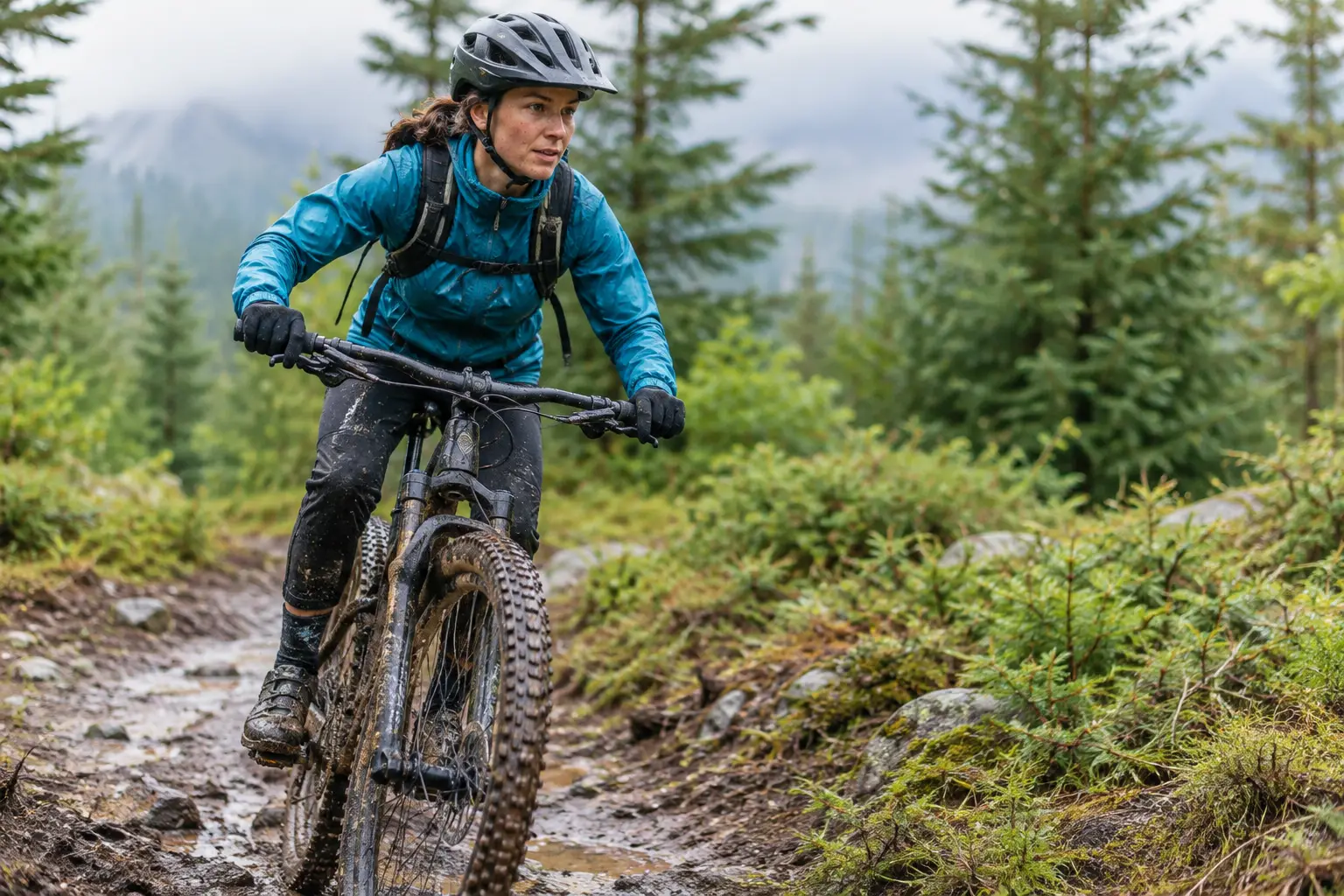
A ribbon of wet roots, a greasy bend and a rear wheel searching for grip: that is exactly why muddy singletrack is brilliant. Learning how to ride muddy singletrack is not about charging harder or buying every bit of kit in the bike shop. It is about reading the trail, staying loose and accepting that a little sideways movement is part of the fun.
For riders training towards an off-road adventure event, mud can turn a familiar route into a proper test. Get the basics right and wet woodland trails stop feeling like a fight. They become the section where calm, committed riding makes the biggest difference.
Start with the right call: should you ride it?
Not every muddy trail should be ridden. There is a difference between a wet, rideable surface and a saturated path that will be badly damaged by tyres. Deep ruts, standing water that has nowhere to drain and a trail that is visibly breaking apart are good reasons to choose another route.
That is not being soft. It is looking after the places we ride so they are still fun next month. Stick to permitted routes, avoid widening the trail to dodge puddles and ride through the line rather than around it where the ground can take it. If a route is closed, respect the closure.
Conditions also change quickly across a loop. A sheltered forest section may hold slick clay long after an exposed track has dried, while wet leaves can hide roots, holes and loose stones. Give yourself a few minutes at the start to work out what sort of grip is available before committing to race pace.
Set your bike up for grip, not bravado
Tyres make a huge difference in mud. A tyre with open, widely spaced knobs clears better than a fast, tightly packed summer tread, helping the rubber find the ground rather than skating on a layer of sludge. You do not always need a full mud-specific tyre, but if wet trails are your regular winter playground, it is one of the most worthwhile changes you can make.
Pressure is the balancing act. Lower pressures let the tyre deform over roots and stones, creating more grip and comfort. Go too low, though, and you risk burping tubeless tyres, damaging a rim or feeling the tyre fold in hard turns. Your ideal number depends on rider weight, tyre width, casing, wheel size and whether you run tubes or tubeless. Start a little lower than your dry-trail setting, then adjust one small step at a time.
Check that your brakes bite cleanly, your chain is lubricated and your gears shift reliably before you leave. Muddy rides are hard on drivetrains. A quick pre-ride check is far better than discovering a skipping chain halfway up a steep, rain-soaked climb.
How to ride muddy singletrack: stay centred and loose
The instinct when the front wheel starts to wander is to stiffen up and grab the bars. Resist it. Heavy hands make the bike twitchier and stop the front wheel from finding its own way through small ruts and slippery patches.
Stand with your pedals level when the trail gets rough, bend your elbows and knees, and keep your weight balanced between both wheels. Think of your arms and legs as suspension. Let the bike move underneath you while your chest stays comparatively calm and centred.
On flatter, greasy ground, a slight shift back can help prevent the front wheel from digging in. But do not hang off the rear of the bike all the time. Too far back and you unload the front tyre, which is exactly the one you need for steering. The goal is not a dramatic body position. It is a strong, neutral stance that keeps both tyres working.
Look further ahead than feels natural. Your bike tends to follow your eyes, and staring at the root you fear is a reliable way to hit it badly. Scan the trail for the next turn, the firmer strip of ground or the exit of a rut. Then let your peripheral vision deal with the mess immediately below you.
Brake before the bend, then let the bike roll
Most muddy crashes begin with braking at the wrong time. If you arrive at a corner too fast, grab both levers and lean the bike over, the tyres have to brake and turn at once on a low-grip surface. Something usually gives.
Do your main braking while the bike is upright and travelling in a straight line. Ease off the brakes before the turn, look through the exit and carry enough speed to stay stable. You may need to enter more slowly than you would in dry conditions, but a controlled roll is better than repeatedly stopping the wheels.
Use both brakes with feel. The front brake provides most of your stopping power, yet a sudden handful on a slippery surface can wash out the front wheel. The rear brake is useful for settling speed, but locking it only creates a skid and removes control. Squeeze progressively rather than snatching.
If the wheels do slide, stay relaxed. A small drift is often recoverable if you keep looking ahead and avoid panic braking. The riders who look smooth in mud are not necessarily gripping harder. They are simply giving the bike room to find traction.
Choose lines that match the ground
In summer, the smoothest line is often the fastest. In mud, the shiny-looking centre of the trail may be the slickest part. Look for texture: exposed stones, roots with a dry edge, leaf-free soil or a slightly raised strip can all offer more purchase.
Ruts need a decision. If the rut is shallow and points where you want to go, commit to it with a light front wheel and steady pedals. If it sends you towards a tree, a drop or the wrong side of the corner, cross it early at a confident angle rather than drifting into it at the last second.
Roots are particularly slippery when wet, especially if you hit them while turning or braking. Approach as squarely as the trail allows, keep your weight light through the bike and avoid sudden pedal strokes. On a rooty climb, smooth power matters more than force. Spin a manageable gear, sit forward enough to keep the front wheel down and accept that there will be days when a short push is the smarter move.
Pedal smoothly and carry useful momentum
Mud punishes big bursts of power. Stamp on the pedals and the rear tyre spins, digs a hole and leaves you going nowhere. Instead, select an easier gear before the climb steepens and keep pressure through the pedals smooth and round.
Momentum is valuable, especially over short rises, roots and soft patches. That does not mean arriving flat-out. It means carrying just enough speed that the bike can keep rolling while you stay balanced. A well-timed gear change before the obstacle is much cleaner than a desperate shift under load halfway through it.
When traction disappears completely, do not turn the moment into a wrestling match. Put a foot down, reset and ride on. There is no prize for coating your drivetrain in mud while spinning the rear wheel in the same place for thirty seconds.
Practise the skills where the consequences are small
You do not need a dramatic descent to improve. Find a safe, gentle slope or open trail section and practise controlled braking, lifting your gaze and allowing a tiny rear-wheel drift. Repeat the same corner at a sensible pace, changing your entry line each time. Familiarity turns the sensation of sliding from alarming to manageable.
Riding with friends helps too. Follow a smoother rider and watch where they brake, where they stand and when they choose to stay off the pedals. Just leave enough space. Muddy singletrack demands more reaction time, and nobody wants to be the person who slides into a mate at the bottom of a descent.
A few practical extras make a wet ride far more enjoyable:
- Wear gloves with reliable grip, even when soaked, and bring a warm layer for stops.
- Carry a plug kit or spare tube, pump, multitool and a way to deal with a snapped chain.
- Fit mudguards if your local trails allow them. Your face and riding mates will thank you.
- Clean and dry your bike after the ride, then relubricate the chain before the next one.
Race day mud: ride your own ride
In an event setting, muddy singletrack can feel more intense because riders bunch up and adrenaline is high. Give yourself extra space on descents, call clearly before passing and do not let another rider’s pace force you into a line you have not assessed.
A brief loss of time through a technical patch is often far cheaper than a crash, mechanical or blown-up climb. Keep your effort controlled, take fuel and fluids before you need them, and save a little concentration for the final kilometres. Mud makes every decision more expensive.
The next wet ride will still splash your kit, clog your tyres and test your nerve. That is part of the deal. Stay light on the bike, deliberate with your braking and respectful of the trail, and you will come out of the woods grinning rather than merely relieved.