
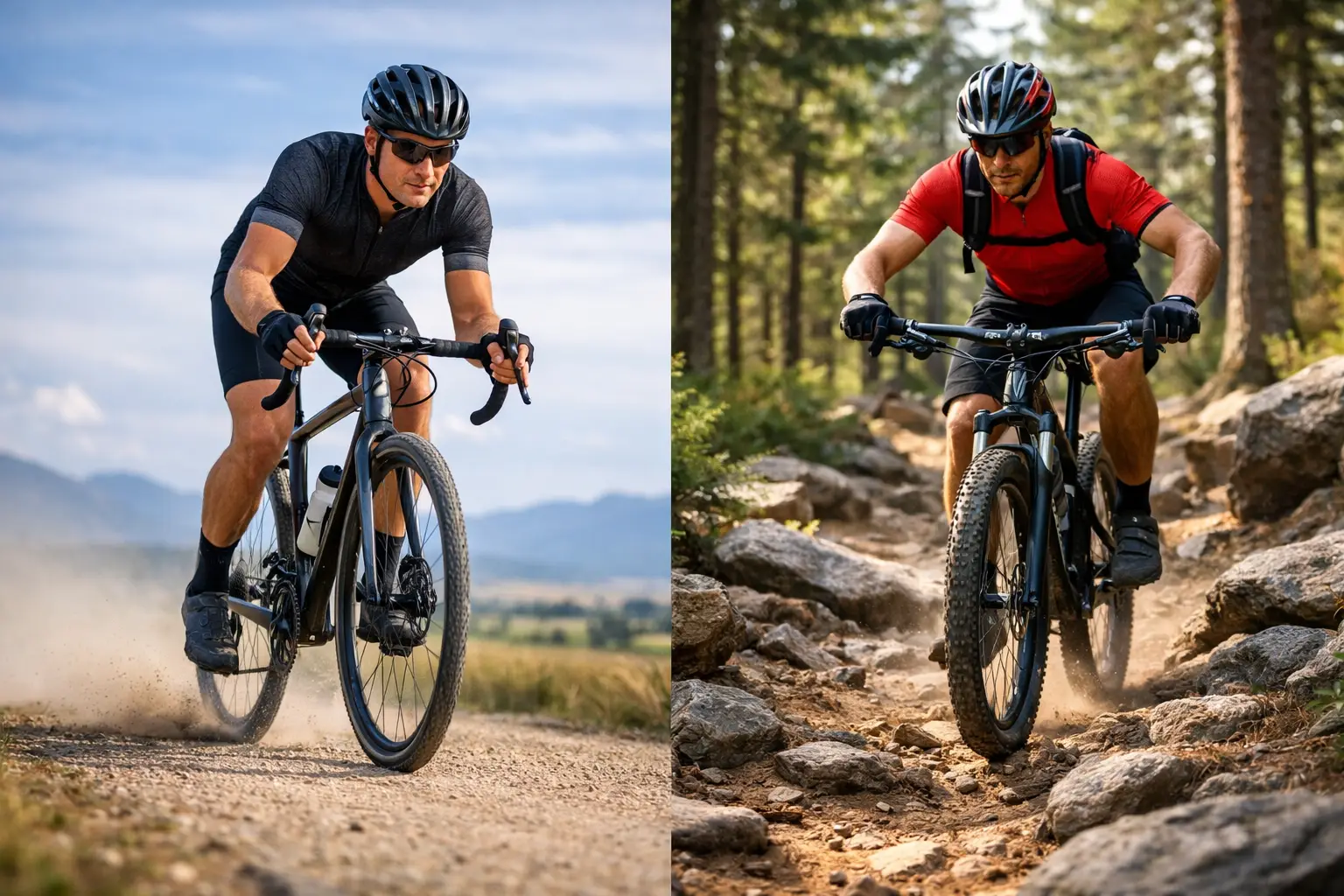
A gravel bike vs mountain bike race choice can change the whole feel of your day. Pick the right bike and you will roll into the ride feeling quick, capable and ready for whatever the route serves up. Pick the wrong one and every loose descent, muddy corner or long drag can feel like hard work.
The answer is not simply that gravel bikes are fast and mountain bikes are tough. It comes down to the terrain, the weather, your skills and what you want from the challenge. If your ideal race day is about covering ground, taking in big views and finishing with plenty left for the trail run, your choice matters even more.
Gravel bike vs mountain bike race: the real difference
A gravel bike is built to move efficiently over mixed surfaces. Think tarmac lanes, hard-packed trails, forest roads, bridleways and dry, flowing tracks. Its dropped handlebars offer multiple hand positions for longer rides, while its lighter frame and faster-rolling tyres make it a strong choice when the course includes plenty of distance and smoother ground.
A mountain bike is made for rougher business. Wider tyres, suspension, flat bars and more relaxed geometry give you extra control when rocks, roots, ruts and steep descents turn up. It may feel slower on open tracks and roads, but it can be dramatically quicker when the surface becomes technical because you spend less time braking, bouncing and fighting for a line.
Neither is automatically the better race bike. A fast rider on an unsuitable bike is still likely to lose time and confidence. The best choice is the one that lets you ride consistently, safely and with a grin on your face.
Choose a gravel bike when the route rewards speed
A gravel bike usually makes sense where the course is predominantly firm, dry and non-technical. If there are long sections of compact gravel, quiet road, canal towpath or wide forestry track, it will carry speed with less effort than a mountain bike.
The riding position is a key part of that advantage. On a long event, being able to move between the hoods, drops and tops can reduce hand and shoulder fatigue. Gravel bikes also tend to climb efficiently on steady gradients, particularly when the ground is predictable enough to stay seated and keep power going through the pedals.
This is the bike for riders who enjoy momentum. You can tuck in on exposed sections, spin along fast tracks and make the most of every smoother mile. It is also a great option if your cycling background is mainly road riding and you are building confidence away from the tarmac.
There is a limit. Gravel bikes can handle more than many people expect, especially with modern wide tyres, but they are not magic. Repeated roots, deep mud, loose rock and sharp drop-offs can become tiring fast. If you are gripping the bars, feathering the brakes and walking features you would otherwise ride, the speed advantage disappears.
Tyre choice can make or break the day
For a dry, quick course, a gravel tyre around 40-45mm with a fast centre tread can feel brilliant. For softer ground, choose a more aggressive tread and consider going wider if your frame allows it. Tubeless set-ups can offer valuable puncture protection and allow lower pressures for comfort and grip, but only if you have practised fitting and maintaining them before race day.
Do not turn up with ultra-slick tyres because the forecast looked kind on Monday. British trails have a habit of holding water, and one greasy woodland section can rewrite the day’s plan.
Choose a mountain bike when control is the priority
If the course includes rocky singletrack, rooty woodland, wet grass, steep technical climbs or proper off-road descents, a mountain bike is often the smart call. It offers margin for error, and margin is valuable when you are racing on tired legs.
Flat handlebars give a wide, stable stance. A suspension fork takes the sting out of repeated impacts and helps the front wheel track over uneven ground. Larger-volume tyres grip better at lower pressures, while a dropper post, if you have one, can make steep descents feel far less intimidating.
A hardtail mountain bike is an excellent all-round event machine. It is simpler and lighter than a full-suspension bike, pedals efficiently and still gives you front-end comfort and confidence. For especially rough terrain, a full-suspension bike can preserve your hands, back and energy, though it may feel less lively on smooth tracks.
The trade-off is clear on faster terrain. A mountain bike’s upright position and knobbly tyres create more rolling resistance. On long road stretches or firm gravel, you may work harder to hold the same pace as a gravel bike. That is not a problem if the course soon turns rough again, but it is worth considering honestly.
Think beyond the bike: match it to your experience
A course profile tells part of the story. Your own riding history tells the rest. An experienced mountain biker may fly around a mixed route on a hardtail while a road rider feels more secure and efficient on a gravel bike. The goal is not to choose the most capable bike on paper. It is to choose the bike you can use well.
Ask yourself what happens when conditions get less friendly. Can you corner confidently on wet roots? Do you know how to weight the bike on a loose descent? Are you comfortable riding in a group on dropped handlebars over uneven ground? Honest answers are useful, not limiting.
If you are new to off-road events, confidence is often worth more than a few theoretical minutes. A bike that encourages you to look ahead, release the brakes and ride smoothly will make the experience better from the first climb to the finish line.
Weather can flip the gravel bike vs mountain bike race decision
Dry trails can make almost any route feel fast. Rain changes the equation. Mud fills tyre tread, hard-packed surfaces become slippery and grass climbs can turn into a test of traction rather than fitness.
A mountain bike’s wider, more aggressive tyres tend to offer a bigger safety net in wet conditions. Suspension can also improve grip by helping the wheels stay in contact with the ground. Gravel bikes remain perfectly capable in poor weather, but they need sensible tyre choice and a rider happy with a livelier feel beneath them.
Check the event information, recent trail conditions and forecast in the days before you travel. If the route is mixed and the weather is uncertain, lean towards the bike that gives you more control on the toughest sections. You will rarely regret extra grip halfway down a wet descent.
Set your bike up for an adventure race
Whichever bike you choose, race-day reliability matters more than chasing marginal gains. Make sure your gears shift cleanly under load, your brake pads have plenty of life and your tyres are in good condition. A tiny mechanical issue can become a big distraction once you are out on the course.
Carry the kit you know how to use: spare tube, tyre plugs if running tubeless, pump or CO2, multitool and a quick link for your chain. Test your hydration and nutrition set-up on a training ride too. An adventure event is not the place to discover that your bottle cage launches bottles over every root.
Practise the kind of riding the route demands. Gravel riders benefit from time on loose corners, descents and uneven trails. Mountain bikers planning a faster mixed-surface course should practise settling into a sustainable pace on longer, smoother sections. The strongest race plan is simple: ride within yourself early, stay fuelled and keep enough in reserve to enjoy the whole challenge.
The bike that gets you to the finish smiling
At SUPBIKERUN, cycling is one part of a bigger outdoor challenge. You still have the paddle and trail run to think about, so burning every match trying to force the wrong bike through the wrong terrain is a poor bargain. Choose the machine that keeps your effort controlled and your attention on the adventure.
A gravel bike can be the fast, freeing choice for flowing routes and big-mile momentum. A mountain bike can be the confidence machine when the ground gets wild. Read the route, respect the conditions and back the bike you are excited to ride. Then get it muddy, share the miles and earn that finish-line feeling.