
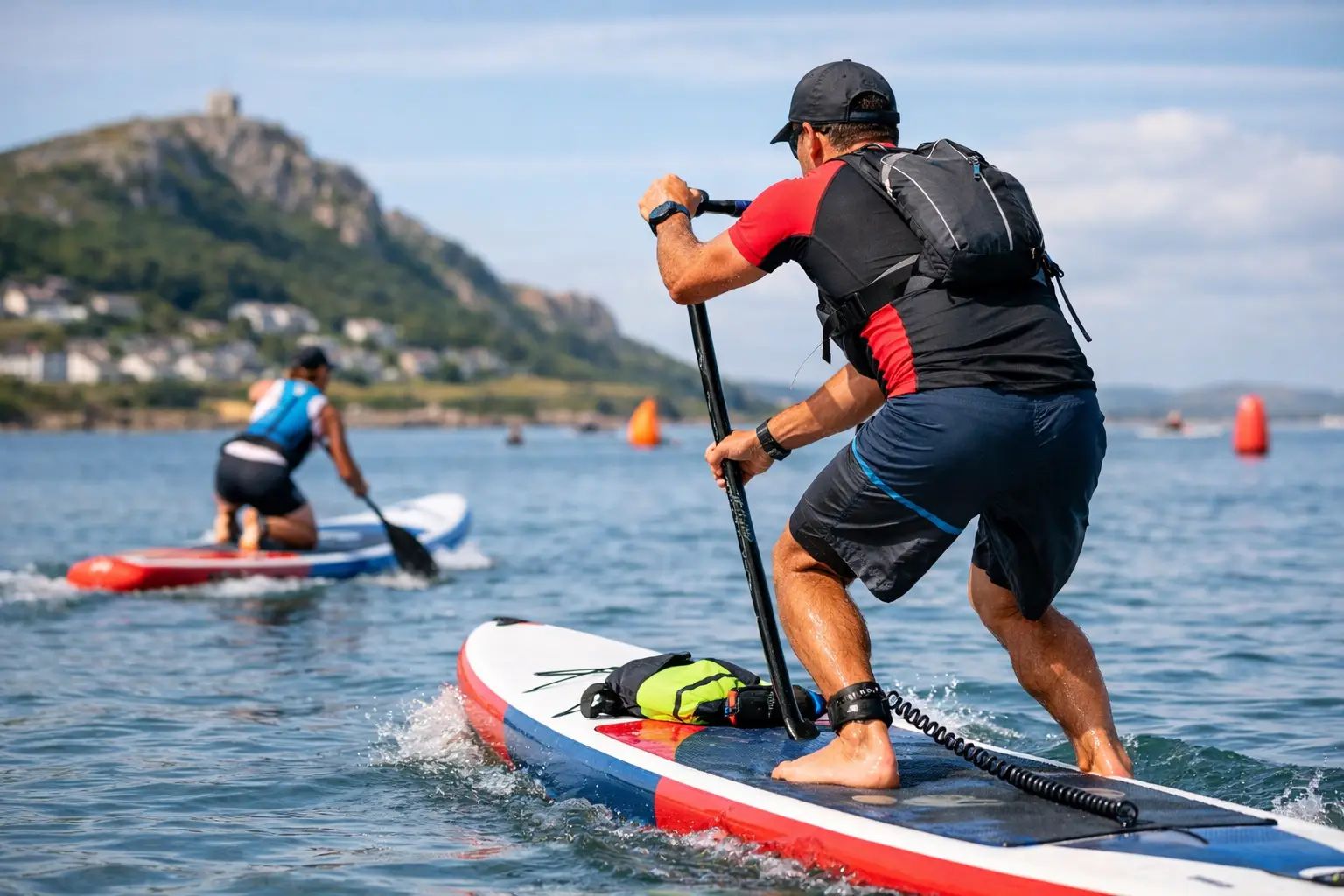
A race paddleboard that feels quick on flat water can feel like a handful once the start horn goes, the wind comes up and everyone around you is throwing spray. The best paddleboard race gear is not simply the lightest or most expensive kit. It is the set-up that keeps you moving confidently, comfortably and safely from your first stroke to the transition mat.
For an adventure race, your paddle leg has a job to do: get you to the next discipline with enough energy left to ride hard and run well. Choose practical gear, test it in real conditions and make race morning feel straightforward.
Best paddleboard race gear starts with the right board
Your board choice shapes the whole experience. A narrow, rigid race board will usually offer the best glide and speed on calm water, but it demands balance, good technique and confidence when conditions turn choppy. That trade-off can be worth it for experienced paddlers chasing places, yet it is not automatically the fastest option for every racer.
For many recreational athletes, a stable inflatable board is the smarter race-day choice. Modern inflatables can be impressively stiff when inflated to the manufacturer’s recommended pressure, are easier to transport and are far more forgiving when you are tired or dealing with boat wash. A board you can paddle consistently is more useful than a sleek board that has you swimming.
Always check the event rules before committing to a board. Some races specify board classes, maximum lengths or whether hard boards are permitted. If you are entering a multi-discipline event, consider the practicalities too. Can you carry, rack and retrieve it without creating stress before the bike leg?
Keep the deck simple and secure
A good deck pad gives your feet traction when they are wet, while a correctly fitted fin helps the board track straight. A larger fin can improve stability and direction, but may be less suitable in shallow or weedy water. It depends on the course, so inspect the race information rather than copying someone else’s set-up.
Use bungees only for what you genuinely need. A small, securely stowed dry bag is useful for essentials on longer courses, but a cluttered deck catches feet and complicates remounting. Race gear should make you faster or safer, not give you another thing to manage.
Paddle, buoyancy aid and leash: the non-negotiables
Your paddle should feel light enough to use efficiently but strong enough to handle the odd rushed start, buoy turn and clumsy transition. An adjustable paddle is ideal while you are learning what works. As a starting point, many paddlers set the handle roughly a hand-width above their head, then fine-tune from there. Too long and your shoulders can work overtime; too short and you lose reach and rhythm.
A well-fitting buoyancy aid is essential race kit. It should sit snugly around your torso without riding up towards your ears when you lift your arms. Try it on over the layers you expect to wear, then practise paddling and remounting in it. The right aid gives you confidence without restricting each stroke.
Leash choice deserves more thought than it often gets. On flat, enclosed water, a coiled ankle or calf leash may be suitable where event rules require it. On moving water, however, a quick-release waist belt is the safer option because it can be released if the leash becomes snagged. Never use a standard ankle leash on a river with a current unless the organiser specifically states it is appropriate and you understand the safety arrangements.
Race requirements vary, so treat the event briefing as part of your kit list. If organisers require a buoyancy aid, leash, whistle or other safety equipment, bring it and know how to use it. That is how a big, lively start stays fun for everyone.
Dress for the water you will be in
British race days have a talent for delivering four seasons between registration and the finish line. Dress for water temperature first, then air temperature and expected effort. You will warm up once paddling, but a swim, a long wait on shore or a windy exposed stretch can change how your body feels very quickly.
For warmer conditions, technical shorts or leggings with a quick-drying top may be enough. In cooler water, a wetsuit can provide welcome warmth and buoyancy, though a full suit may feel restrictive for some paddlers and can slow a bike-and-run transition. A sleeveless wetsuit, wetsuit shorts or a thin neoprene top can be a useful middle ground.
Avoid cotton. It holds water, gets heavy and stays cold. Choose close-fitting technical layers that will not catch on the deck pad or flap around in the wind. Rash vests protect shoulders from sun and reduce rubbing from a buoyancy aid, while lightweight waterproof shells are valuable when the forecast looks unsettled.
Neoprene shoes or water shoes are worth considering if the launch and exit are rocky, muddy or slippery. They should drain well and stay on your feet when you remount. Barefoot paddling offers great board feel, but save it for courses where you know the ground underfoot is kind.
Hydration and fuel without the faff
If your paddle section is short, you may not need to carry much beyond the mandatory safety kit. For longer efforts or a full adventure triathlon, hydration and easy-to-open fuel can make a real difference. A soft flask tucked securely under deck bungees, or a small hydration pack if permitted, is usually easier than trying to manage a bottle rolling around on the board.
Choose fuel you have already used in training. Gels, chews or small bars should be easy to open with wet hands, and any wrappers need to be stowed – never dropped into the water or left at a transition. Keep portions modest. A huge snack that is difficult to chew while balancing is not a race strategy.
Practise drinking while kneeling or standing at an easy pace. It sounds basic, but race-day confidence comes from having done the fiddly bits before. If you are combining paddleboarding with cycling and trail running, begin fuelling early rather than trying to rescue the final run with one desperate gel.
Build a transition set-up that works when you are tired
The fastest transition is often the least complicated one. Lay out only what you need, in the order you will use it: bike shoes, helmet, race belt if required, nutrition and anything you need to change out of after the paddle. A bright towel can mark your space and give you somewhere clean to stand, but do not rely on a vast spread of kit.
Think through wet feet. Some racers are happy to put on cycling shoes straight away; others prefer a quick wipe and dry socks. Neither is universally right. Test both during a brick session and choose the option that lets you move without blisters or faffing with cramped fingers.
For SUPBIKERUN-style multi-sport racing, make every handover calm and repeatable. Your board should be deflated, carried or racked exactly as the event instructions require, and loose paddle gear should never be left where another competitor might trip. Good transition etiquette is part of the community spirit as much as it is good racecraft.
A race-day paddleboard gear check
Pack the night before, then give everything one final look before leaving home. The essentials are straightforward, but each matters:
- Board, pump, fin and the correct valve adaptor
- Paddle and a backup fastening or tape for minor emergencies
- Buoyancy aid and the leash type required for the course
- Suitable paddle clothing, plus dry layers for after the finish
- Water, familiar fuel and any mandatory race equipment
- Towel, transition footwear and a bag for wet kit
Inflate your board early enough to check the valve, fin and leash attachment properly. A quick equipment problem is much easier to solve in the car park than five minutes before the briefing. Mark your board and paddle clearly if the event allows it, especially when dozens of similar inflatables are stacked together.
Train with the gear you plan to race in
The final piece of the best paddleboard race gear is familiarity. Paddle in your buoyancy aid, practise turns around a marker, fall in and remount, and try a short paddle straight into a bike or run. You will quickly learn whether your paddle length works, your shoes rub or your chosen layers are too warm.
Do not wait for perfect conditions either. A breezy training session teaches you how your board behaves when the water is lively, while a calm session is ideal for refining efficient strokes. Both build the kind of confidence that makes an event feel like an adventure rather than an equipment test.
Bring kit you trust, listen carefully at the safety briefing and leave space to enjoy the water. The right gear will not do the paddling for you, but it will let you focus on the brilliant bit: taking on a challenge with a whole race community behind you.