
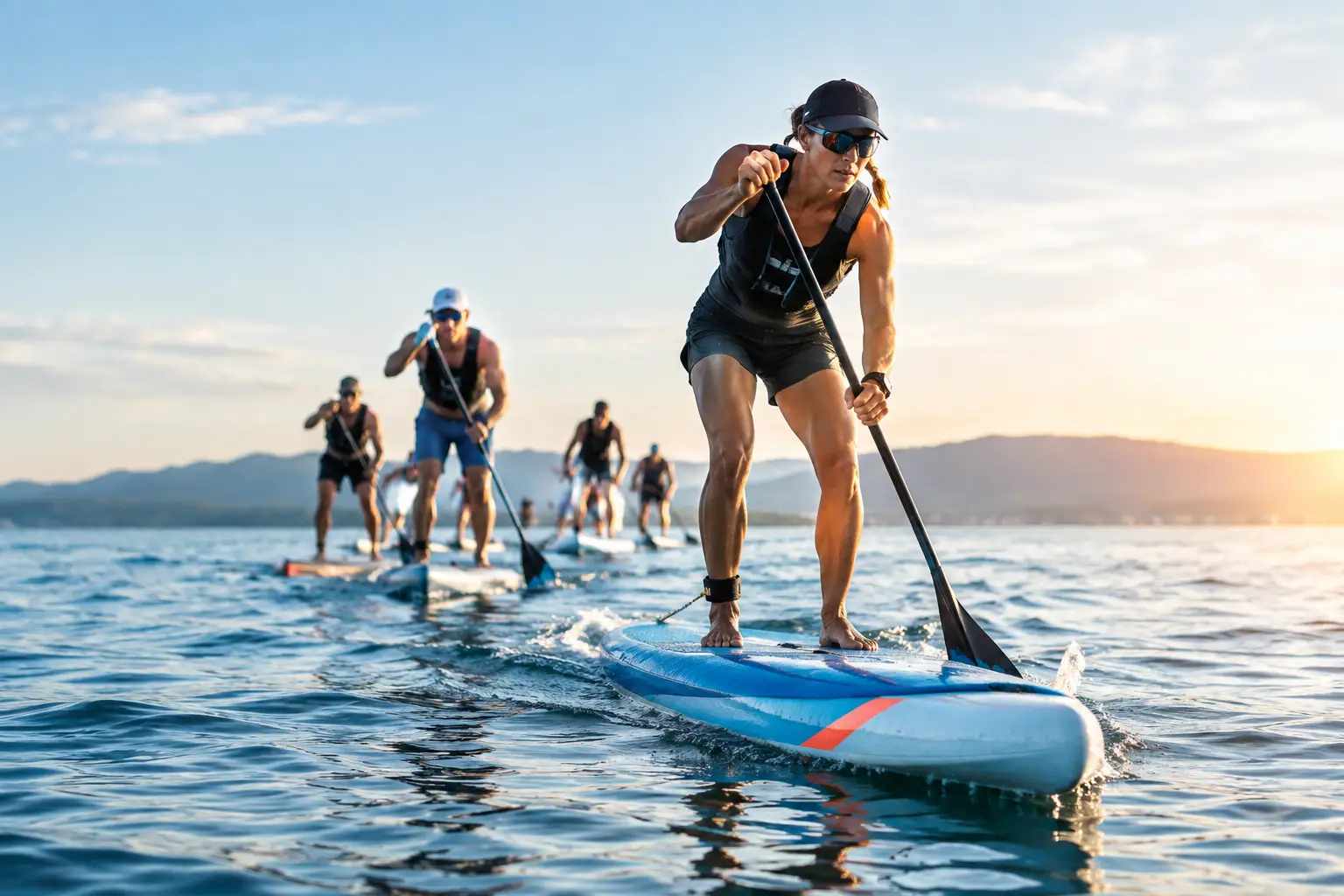
Cold water on your ankles, a board under your feet and a start line ahead is a brilliant feeling. Paddleboarding safety is what lets you enjoy that buzz properly – whether you are training for an adventure triathlon, joining friends on a lake or testing yourself on a longer route.
This is not about taking the adventure out of paddleboarding. It is about making smart calls early, looking after your mates and arriving at the bike leg with energy left to race.
Paddleboarding safety begins before launch
The biggest safety decision is often made before your board touches the water. Check the forecast, but do not stop at the little weather icon. Wind direction and strength, gusts, water temperature, rainfall, visibility and the character of the venue all matter. A sunny day can still bring a hard headwind or chilly water that changes the challenge completely.
Think about where the wind will take you if you stop paddling. Offshore wind can push a board and rider away from the bank far faster than expected. On a river or canal, look for current, weirs, narrow sections, boat traffic and places where getting out would be difficult. On open water, know your landing points and avoid setting out without a realistic return plan.
For an event, follow the course briefing rather than assuming your usual paddling habits apply. A marked route may have turns, bottlenecks, marshals, safety craft and other competitors to consider. SUPBIKERUN courses are designed to feel adventurous, but the rules, cut-offs and instructions are there to keep that adventure moving in the right direction.
Tell someone where you are going if you are paddling independently. Better still, paddle with someone whose pace and confidence are compatible with yours. Being part of a group is useful only if the group stays aware of one another.
Match the route to your real ability
Your ability on a calm, warm lake is not necessarily your ability in wind, waves or cold water. Be honest about your experience, especially if your only practice has been short summer sessions close to shore.
A sensible progression builds skill before distance. Learn to paddle efficiently, turn your board, step back to control the nose and remount from deep water. Practise falling in on purpose in a safe, supervised setting. It sounds basic, but it removes the shock of an unexpected swim and proves that you can get back on your board when you are breathing hard.
If conditions look beyond your comfort zone, change the plan. A shorter loop, a sheltered launch point or a skills session is a good day outdoors. Pressing on because everyone else appears confident is how manageable conditions become a rescue.
Wear the kit that gives you options
A board in good condition, a paddle that is the right length and a properly fitted buoyancy aid are your non-negotiables. Your buoyancy aid should be suitable for paddlesports, fit snugly and allow full movement through your shoulders. Do not leave it clipped to your board or assume you will put it on if things get lively.
Your leash choice depends on the water. On enclosed, still water, a leash keeps your board close – and your board is a large, visible flotation platform. For moving water, use a quick-release waist leash designed for that environment and understand exactly how to operate it. A standard ankle leash can create an entrapment hazard around obstructions or current. If you are unsure, ask a qualified paddlesports instructor or follow the event organiser’s specific guidance.
Dress for immersion, not for the air temperature at the car park. In the UK, water can be cold well into spring and surprisingly cold after a hot spell. A wetsuit may be right for a colder venue or longer session, while technical layers can work well when the water is warmer. Avoid heavy cotton, which holds water and steals warmth.
For a race or longer adventure, carry what can genuinely help: a securely attached mobile phone in a waterproof case, water, a whistle, and any compulsory kit set by the organiser. Keep loose items contained. A bottle drifting away is frustrating; a poorly secured bag caught around your feet is a hazard.
Read the water, not just the route map
Conditions change once you are on the board. Keep scanning ahead for wind lines, surface chop, boat wakes, floating branches and other water users. Look behind you regularly too, particularly before changing direction or crossing a busier stretch.
Boat wake deserves respect without drama. Drop to your knees if you need more stability, turn the board to face the wake and keep a soft bend in your knees. Trying to stand tall and rigid is a fast route to an unplanned swim. There is no prize for staying upright in every situation – controlled choices are faster than a fall.
Give wildlife space and be courteous around anglers, swimmers, sailors and boaters. Slow down where necessary and make your line predictable. On narrow water, avoid blocking the channel while chatting or waiting for others. Adventure sports feel better when everyone using the water gets room to enjoy it.
Know when to stop
Fatigue is not always dramatic. It can show up as clumsy paddle strokes, poor balance, shivering, a vague feeling of being overwhelmed or the temptation to ignore a worsening wind. Those are useful signals, not something to tough out.
If you are cold, get off the water early and warm up. If you cannot make progress into the wind, head for a safe exit rather than battling on. If a fellow paddler is struggling, stay with them if it is safe to do so, alert organisers or emergency support, and avoid creating a second casualty.
In an organised event, tell a marshal if you retire. It takes seconds and prevents a search for somebody who is already dry, warm and halfway to a coffee.
Race-day habits that keep the fun high
Adventure triathlon adds another layer: you need to manage your effort, transitions and attention across more than one discipline. Going flat out in the opening paddle may feel heroic, but it can leave you shaky when it is time to mount the bike or hit the trail.
Arrive early enough to set up without rushing. Check your board, fin, leash mechanism and buoyancy aid before the briefing. Know where your transition area is, how your kit is laid out and what you need to take with you. A simple routine reduces pre-race nerves and stops small oversights becoming distractions.
At the start, give yourself space. You do not have to sprint into the busiest line if it compromises your balance or puts your paddle near somebody else’s board. Settle into a rhythm, breathe and paddle your own race. The strongest day is rarely the one with the most frantic first five minutes.
Hydration matters even when the weather is cool. So does fuelling, particularly if you are moving on to cycling and trail running. Test food, clothing and equipment in training where possible. Race day is for enjoying the challenge, not discovering that a new hydration pack rubs or a different fin makes your board track badly.
Build confidence that lasts beyond one event
The safest paddlers are not necessarily the ones with the flashiest boards or the longest social media highlights. They are the people who keep learning. A coached session can sharpen your forward stroke, rescue technique, turning and decision-making quickly. Paddling with more experienced friends helps too, provided the group makes room for questions rather than pretending conditions are always easy.
Keep a mental note after each outing: what the wind did, how your clothing worked, whether your board felt stable and when your energy dipped. Those small observations build judgement, which is the skill that matters when the forecast is imperfect and the start line is calling.
Bring the right kit, listen at the briefing and stay alert to the water in front of you. Then get on the board, back your preparation and enjoy the kind of challenge worth talking about long after the finish line.